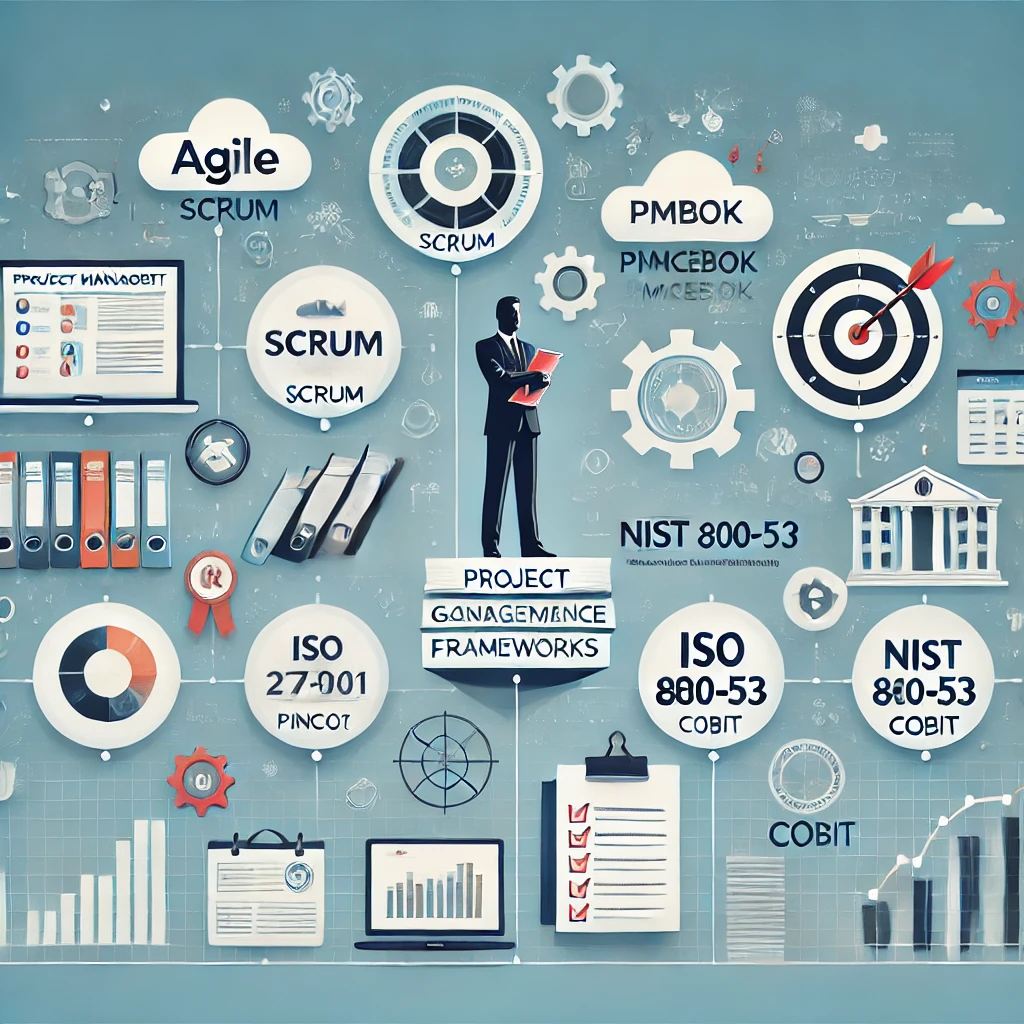
The world of project execution is filled with a wide variety of frameworks, standards, and best practices. Some are focused on project management methodologies—like Agile, Scrum, PRINCE2, and PMBOK. Others center around compliance, governance, and security—such as ISO 27001, COBIT, and NIST 800-53.
But how did we end up with so many? And more importantly, how do you choose the right one for your environment?
A Brief History of Frameworks
- PMBOK (Project Management Body of Knowledge) – Developed by PMI, the first edition was released in 1996, formalizing project management into five process groups and ten knowledge areas. It’s widely used across industries for structured, documentation-heavy projects.
- PRINCE2 (Projects IN Controlled Environments) – Originated in the UK government sector in the 1980s and later released as PRINCE2 in 1996. It focuses on process-based control and clear role definitions, and it’s still heavily adopted in the UK, Europe, and government contracts.
- Agile & Scrum – Born from the software world in the early 2000s, Agile promotes iterative work cycles, minimal documentation, and high responsiveness to change. Scrum, a subset of Agile, structures work into sprints with daily standups and team-owned execution.
- NIST 800-53 – First published by the National Institute of Standards and Technology in 2005 (rev 1), it outlines security and privacy controls for federal information systems. It’s often referenced in compliance-heavy projects and cybersecurity programs.
- ISO/IEC 27001 – Part of the ISO 27000 family, first published in 2005, it sets standards for Information Security Management Systems (ISMS). It’s widely adopted by enterprises and service providers that handle sensitive data.
- COBIT (Control Objectives for Information and Related Technologies) – Released in the mid-1990s by ISACA, COBIT is focused on IT governance, bridging technical controls and business needs.
Why So Many?
Because not all projects are created equal. A small Agile software team has very different needs than a national infrastructure rollout with multiple vendors and compliance mandates. Some frameworks are lightweight, ideal for speed. Others are rigorous—designed to manage risk, documentation, and accountability at scale.
When to Use What
- Use Agile/Scrum for small, iterative software development projects where scope may evolve.
- Use PRINCE2 or PMBOK for complex, multi-phase programs involving multiple stakeholders and strict documentation.
- Use ISO 27001, NIST, or COBIT when regulatory compliance, risk management, or governance are key pillars.
The Role of the Technical PM
Here’s where experience matters. A Technical Project Manager familiar with both PM methodologies and compliance frameworks doesn’t just follow processes—they adapt, blend, and align them to real-world environments.
- Need to ensure a project aligns with NIST or ISO standards? A technical PM maps your execution to the necessary controls.
- Dealing with vendors on a data center rollout? A technical PM uses PRINCE2-style milestones and change control.
- Launching a cloud-based tool? Agile may get it done faster—but only if the PM understands what corners can be safely cut.
In short, frameworks are tools. The right Technical PM knows how to use them—individually or in combination—to build something reliable, compliant, and successful.